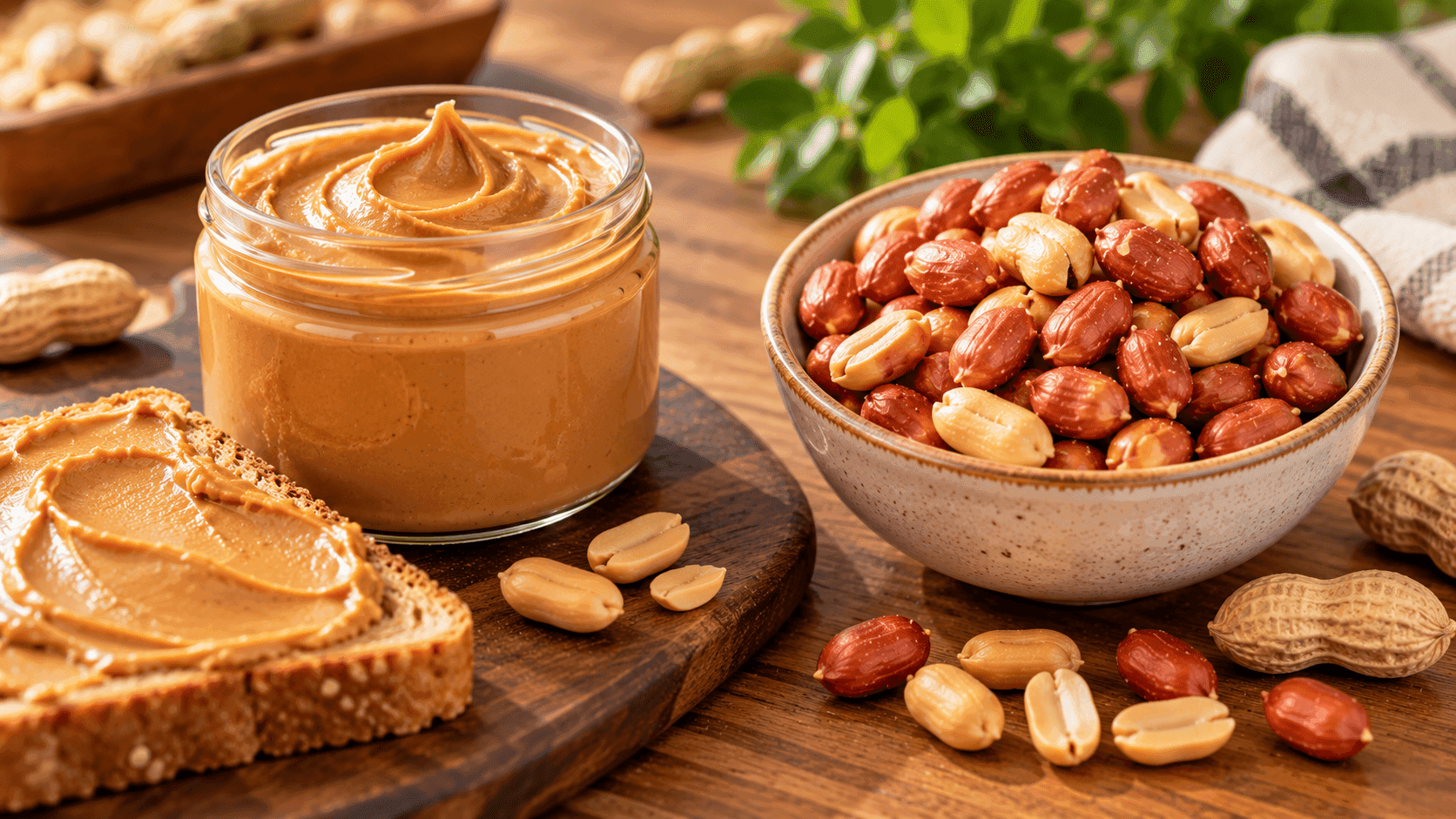
Quick Answer: Which Is Better for Your Daily Snacking Matrix?
While both 100% natural peanut butter and whole hot-air roasted peanuts share an identical macro-nutritional profile on standard food labels—delivering approximately 25.8g of plant-based protein, 49.2g of lipids, and 8.5g of dietary fiber per 100g—their physiological impact, satiety duration, and lipid absorption mechanics differ fundamentally due to the food matrix effect.
Peanut butter is produced by mechanical stone milling or high-shear rotor-stator grinding, which pulverizes the parenchymal cell walls of Arachis hypogaea. This process liberates intracellular oleic and linoleic oil droplets, making lipids and calories virtually 100% bioaccessible to pancreatic lipase upon ingestion. In contrast, whole hot-air roasted peanuts retain rigid cell wall structures. Human mastication breaks only a fraction of these cells, leaving up to 18%–24% of lipid calories encapsulated within intact cell walls that pass through the digestive tract unabsorbed.
Choose whole roasted peanuts when seeking superior satiety, calorie control, oral mastication satisfaction, and portably clean workday or tea-time chakhna. Choose natural peanut butter when requiring rapid post-workout calorie density, smooth texture integration for smoothies, or elevated spreads without added hydrogenated fats or refined sugars.
“Macro labels display equal calories, but whole roasted peanuts yield lower net metabolizable energy due to incomplete cellular breakdown during human chewing.”
The Food Matrix Effect: Cell Wall Integrity vs Mechanical Milling
To understand why equal weights of peanut butter and whole peanuts perform differently in the human digestive system, FMCG food scientists analyze the food matrix—the physical and structural arrangement of nutrients within food cells.
When peanuts undergo dry-air roasting at controlled temperatures (140°C–160°C), thermal moisture loss renders the cotyledon tissue crunchy and brittle while preserving cellular compartmentalization. Chewing whole peanuts breaks the kernel into macro-particles (0.5mm to 3mm). Because human teeth do not micro-grind every individual parenchymal cell, a substantial portion of the peanut fat remains locked inside intact cell structures.
In peanut butter processing, industrial colloid mills subject roasted peanuts to high mechanical shear forces under tight tolerances (<50 microns). This destroys cellular compartmentalization entirely, converting solid cotyledon matrix into a continuous liquid lipid phase holding suspended solid protein and fiber fragments. As a result, peanut butter presents instantaneous surface area access for digestive enzymes.
“Colloid milling converts peanut fat from encapsulated cellular droplets into a free-flowing liquid oil phase, accelerating enzymatic breakdown.”
Satiety Dynamics, Mastication Time, and Calorie Intake Volatility
Satiety is mediated by mechanical, hormonal, and psychological signals triggered during eating. Whole roasted peanuts excel in mechanical oral sensory processing: chewing 30 grams of crunchy roasted peanuts requires 30 to 45 seconds of active mastication, driving salivary alpha-amylase interaction and sending early fullness signals to the hypothalamus via the vagus nerve.
Furthermore, chewing whole peanuts triggers the gastrointestinal release of appetite-suppressing peptide hormones, specifically Cholecystokinin (CCK) and Peptide YY (PYY), well before bolus transit reaches the stomach. This oral effort prevents rapid overconsumption.
Conversely, peanut butter is an ultra-palatable semi-fluid paste requiring zero mastication. It bypasses oral fatigue mechanics, making portion overshoot common—a single extra tablespoon adds ~100 kcal without registering proportional oral satiety. For controlled everyday office breaks or tea-time chakhna, whole roasted peanuts provide built-in portion pacing.
Protein Bioavailability, Amino Acid Access, and Thermal Roasting
Peanuts are a rich source of plant-based protein, providing all essential amino acids with high levels of arginine, glutamic acid, and aspartic acid. However, protein digestibility is directly influenced by the physical openness of the protein bodies (aleurone grains).
In whole roasted peanuts, stomach gastric juices (pepsin and hydrochloric acid) must penetrate intact cotyledon matrix chunks, resulting in a gradual, sustained release of amino acids over 3 to 5 hours. This slow-release digestion makes whole peanuts an outstanding evening snack, suppressing nighttime hunger pangs.
In smooth peanut butter, freed protein fragments interact immediately with gastric pepsin and duodenal trypsin. Amino acid absorption spikes faster in the portal vein, making 100% natural peanut butter an ideal immediate recovery option following intense physical exertion.
Decoding FMCG Labels: Commercial Peanut Butter vs Pure Roasted Peanuts
When purchasing packaged peanut products in the Indian retail or quick-commerce market, ingredient purity is paramount. Whole roasted peanuts offer intrinsic transparency: high-quality products contain only premium bold-grade roasted peanut kernels and a trace amount of iodized or rock salt.
Commercial ultra-processed peanut butter spreads, however, frequently contain hidden additives. To prevent natural oil separation (where peanut oil floats to the top), commercial manufacturers often incorporate fully or partially hydrogenated vegetable oils (palm oil, cottonseed oil), introducing trans fats or high saturated fat loads. Additionally, artificial emulsifiers (mono- and diglycerides), refined sugars, high-fructose corn syrup, and excessive sodium are routinely added.
Consumers seeking clean nutrition should insist on 100% single-ingredient peanut butter (peanuts only) or opt for dry-roasted whole peanuts like BN BundleNuts Salted or Masala Roasted Peanuts, which guarantee zero trans fats, zero added palm oil, and zero synthetic preservatives.
“Always inspect peanut butter labels for hidden palm oil, hydrogenated fats, and added sugars; dry-roasted peanuts provide natural single-ingredient integrity.”
Matching the Product to Your Daily Snacking Occasions
To maximize utility, align your snack choice with your immediate lifestyle context:
1. Office Desk & Workday Focus: Whole hot-air roasted peanuts (such as Salted Roasted Peanuts or Hing Jeera Peanuts) are ideal. They require no spoons or refrigeration, offer mess-free handling, and provide tactile crunch that aids mental alertness without causing post-prandial sluggishness.
2. Evening Tea-Time & Social Chakhna: Whole spiced roasted peanuts (Chilli Garlic or Masala Roasted Peanuts) deliver robust authentic Indian spice profiles that complement warm chai or social gatherings without heavy deep-fried oil residues.
3. Pre/Post Workout Fueling: 100% natural peanut butter spread on whole-grain toast or blended into fruit smoothies delivers rapid caloric energy and easily accessible amino acids to working muscle tissue.
4. On-the-Go Travel & Commute: Single-serve nitrogen-flushed pouch packs of whole roasted peanuts offer shelf-stable freshness, structural durability in bags, and effortless portion control.
Frequently Asked Questions (FAQs)
Q: Does peanut butter have more calories than roasted peanuts? No. Gram for gram, 100% unadulterated natural peanut butter and dry-roasted peanuts have virtually identical caloric values (~567 kcal per 100g). However, because peanut butter is denser and easier to swallow rapidly, people tend to consume larger calorie quantities in a single sitting.
Q: Is whole roasted peanut fat healthier than peanut butter fat? Both contain identical heart-healthy monounsaturated (oleic acid) and polyunsaturated (linoleic acid) fatty acids, provided the peanut butter is 100% pure. If the peanut butter contains hydrogenated palm oil, whole roasted peanuts are significantly healthier due to the total absence of industrial trans fats.
Q: Why does oil separate in natural peanut butter but not in whole peanuts? Whole peanuts retain oil inside intact cell walls. In natural peanut butter, stone milling ruptures cell walls, freeing liquid oil. Without synthetic emulsifiers or hydrogenated fats, this light oil naturally rises to the surface over time.
The BundleNuts Commitment to Clean Roasted Excellence
At BN BundleNuts, we believe in honest, clean, and uncompromised Indian snacking. Our peanut range utilizes premium bold-grade Indian groundnut kernels, precision hot-air roasted without deep-frying, oil soaking, or synthetic artificial flavors.
Whether you enjoy our classic Salted Roasted Peanuts, zesty Hing Jeera Peanuts, or fiery Chilli Garlic Peanuts, every batch is packaged under stringent hygiene standards to deliver perfect crunch, pristine lipid integrity, and pure everyday satisfaction.