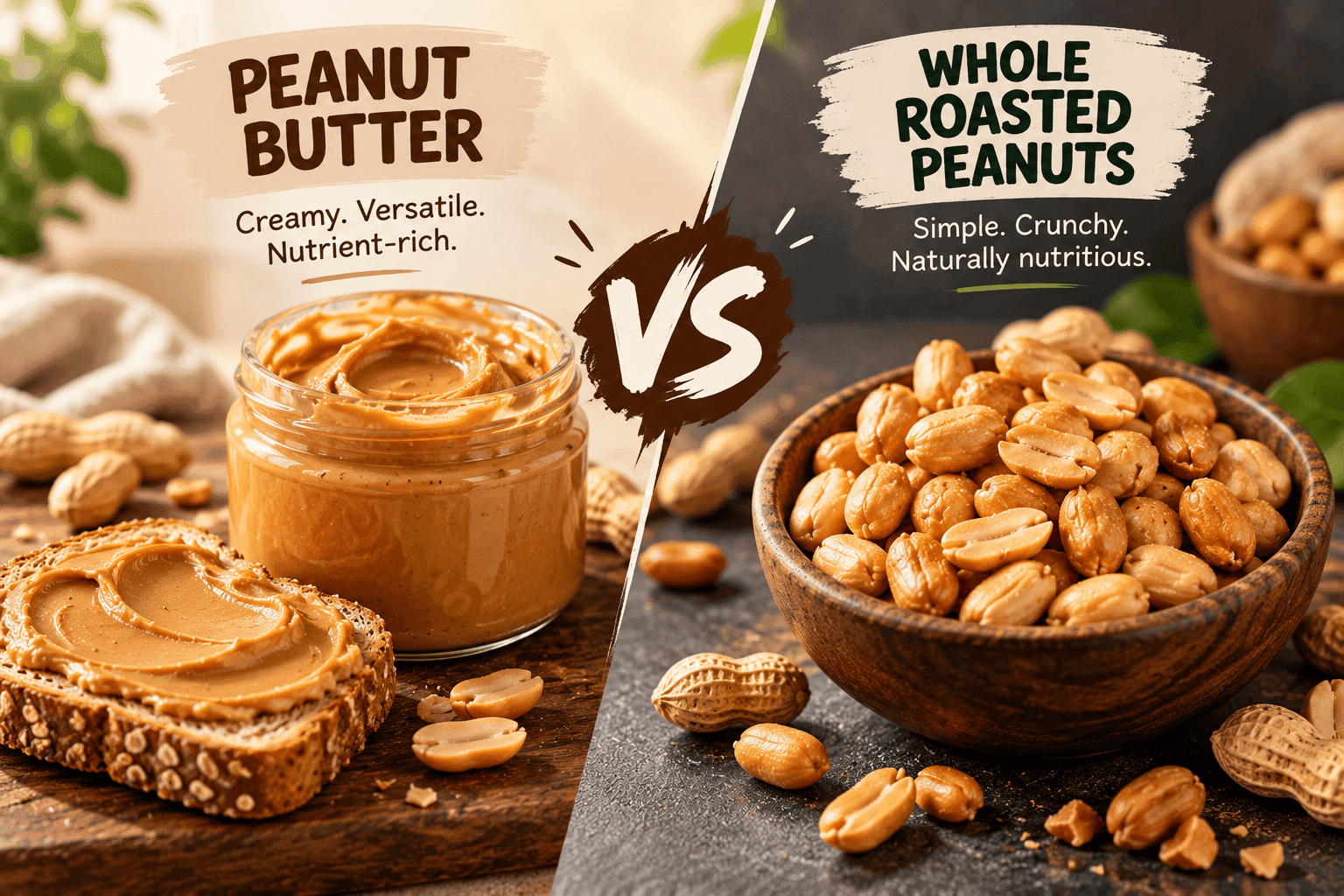
Quick Answer: Peanut Butter vs Whole Roasted Peanuts
From a raw macronutrient perspective, 30 grams of unadulterated peanut butter and 30 grams of whole roasted peanuts contain near-identical gross amounts of plant protein (~7g–8g), dietary lipids (~14g–15g), and total calories (~160–180 kcal). However, from a digestive and physiological perspective, they act as completely distinct foods due to the **Food Matrix Effect**.
Mechanical milling ruptures rigid plant cell walls (parenchyma cells), liberating encapsulated oil droplets into a free-flowing emulsion. This renders the fat in peanut butter highly bioaccessible, leading to near 100% gastrointestinal lipid absorption and rapid gastric emptying. Conversely, chewing whole roasted peanuts leaves intact cellular structures that pass through the digestive tract unabsorbed, expelling roughly 11% to 17% of total lipid energy while delivering superior chew mastication satiety and lower glycemic spikes.
The Science of Micro-Milling and Cell Wall Integrity
In whole roasted peanuts (*Arachis hypogaea*), native lipids are safely sequestered inside microscopic intracellular compartments called **oleosomes** (lipid droplets), surrounded by tough cell walls composed of cellulose, hemicellulose, and pectin. When human teeth masticate whole roasted peanuts, only a fraction of these cell walls are fractured. Microscopic digestive imaging reveals that large particles (>1mm) retain intact cellular matrices, preventing digestive lipase enzymes from accessing the enclosed fats.
During commercial peanut butter production, heavy industrial stone or stainless steel pin mills subject roasted peanuts to extreme shear force. This process reduces particle size down to sub-50 micron levels. Micro-milling completely pulverizes plant cell structures, releasing all sequestered oleosomal oil into a continuous liquid oil phase. As a result, the digestive enzymes in human small intestines can instantly hydrolyze 98%–99% of the fat content in peanut butter.
Calorie Bioaccessibility, Satiety Index, and Portion Dynamics
Clinical nutrition studies evaluating fecal lipid excretion demonstrate that individuals consuming whole peanuts excrete significantly more fat in their stool compared to those consuming smooth peanut butter or peanut oil. This phenomenon means the net metabolisable energy (Atwater factor efficiency) of whole roasted peanuts is lower than their nominal laboratory bomb-calorimeter rating. You absorb fewer net calories from a palmful of whole roasted peanuts than from an equivalent weight of smooth peanut butter.
Furthermore, satiety—the feeling of fullness that suppresses hunger after eating—is heavily influenced by food structure and oral processing duration. Whole roasted peanuts demand substantial mastication, stimulating mechanoreceptors in the jaw and prolonging oral contact time. This extended mastication triggers cephalic-phase hormonal releases (including cholecystokinin CCK and peptide YY) before the food even reaches the stomach. In contrast, smooth peanut butter can be consumed rapidly with minimal chewing, making passive overconsumption far easier.
Ingredient Integrity: Hydrogenated Oils, Emulsifiers, and Sodium
When evaluating commercial peanut spreads in Indian retail channels, consumer vigilance is essential. Natural peanut butter consists solely of 100% roasted groundnuts (and optional salt). However, many mass-market commercial spreads add **fully or partially hydrogenated vegetable oils** (such as palm oil, cottonseed oil, or soybean oil) as stabilizer emulsifiers to stop oil separation on retail shelves. These additives introduce saturated or trans fats and dilute the intrinsic micronutrient density of the groundnut.
Additionally, many commercial peanut spreads add refined sugars, high fructose corn syrup, or corn starch solids to mask bitterness and extend shelf life. Whole dry roasted peanuts, such as [BN BundleNuts Salted Roasted Peanuts](/products/daily-chakhna/salted-roasted-peanuts), contain zero added hydrogenated oils, zero added refined sugars, and zero artificial preservatives—offering a completely clean, whole-food ingredient panel.
How to Integrate Peanut Butter and Whole Peanuts into Daily Routine
Both whole roasted peanuts and pure peanut butter can form part of a balanced diet when selected thoughtfully based on consumption occasions and metabolic goals:
1. **Pre-Workout Fuel & Energy Density:** If you require rapid, dense energy before intense physical activity or endurance training, 1 to 2 tablespoons of 100% pure peanut butter on fruit or whole-grain toast provides quickly accessible calories and plant protein without gastrointestinal heaviness.
2. **Desk, Office & Evening Tea-Time Chakhna:** For daily office breaks, evening tea-time snacking, or casual gatherings where appetite control and deliberate portioning are paramount, whole hot-air roasted peanuts are superior. Their solid matrix delays gastric emptying, satisfies oral crunch cravings, and prevents post-snack energy crashes.
3. **Portion Control Practice:** Always portion whole roasted peanuts into a small ramekin or bowl (approx. 28g–30g, containing ~160 kcal) rather than eating directly from large bulk packaging.
Frequently Asked Questions
**Q1: Does peanut butter have more calories than whole roasted peanuts?** Gross laboratory bomb-calorimeter calorie counts are identical per gram (approx. 5.8–6.0 kcal/g). However, because peanut butter is micro-milled, your digestive system absorbs virtually 100% of those calories, whereas whole roasted peanuts yield roughly 10%–15% fewer absorbed calories due to unruptured cell walls and fecal lipid excretion.
**Q2: Is peanut butter healthier than eating whole peanuts?** Neither is inherently 'healthier,' but they serve different dietary needs. Pure peanut butter offers concentrated, easily digestible energy for high-performance athletes or weight-gain goals. Whole roasted peanuts provide superior satiety, lower net calorie absorption, higher oral chewing satisfaction, and zero risk of added hydrogenated oils.
**Q3: Why does oil separate on top of natural peanut butter?** Natural peanut butter contains no synthetic emulsifiers or hydrogenated fats. Over time, gravity causes the natural groundnut oil released during milling to float to the top. Stirring the oil back into the jar or storing it upside down in the refrigerator prevents separation cleanly.
**Q4: How do BN BundleNuts Roasted Peanuts compare?** BN BundleNuts uses premium bold-grade Indian groundnut kernels that are hot-air roasted without deep-frying in oil. They offer pristine crunch, clean flavor, and full cell matrix integrity for healthy daily snacking.
The BundleNuts Commitment to Clean Roasted Excellence
At BN BundleNuts, we believe in honest, clean, and uncompromised Indian snacking across our [Daily Chakhna](/products/daily-chakhna) category. For more details on groundnut digestion and roasting science, explore our [Roasted Peanuts vs Raw Peanuts Digestibility Guide](/blog/roasted-peanuts-vs-raw-peanuts-digestibility-guide) and [How to Choose Roasted Peanuts for Office Snacking](/blog/how-to-choose-roasted-peanuts-office-tea-time-snacking). Our peanut range utilizes premium bold-grade Indian groundnut kernels, precision hot-air roasted without deep-frying, oil soaking, or synthetic artificial flavors.
Whether you enjoy our classic [Salted Roasted Peanuts](/products/daily-chakhna/salted-roasted-peanuts), zesty [Hing Jeera Peanuts](/products/daily-chakhna/hing-jeera-peanuts), or fiery [Chilli Garlic Peanuts](/products/daily-chakhna/chilli-garlic-peanuts), every batch is packaged under stringent hygiene standards to deliver perfect crunch, pristine lipid integrity, and pure everyday satisfaction.