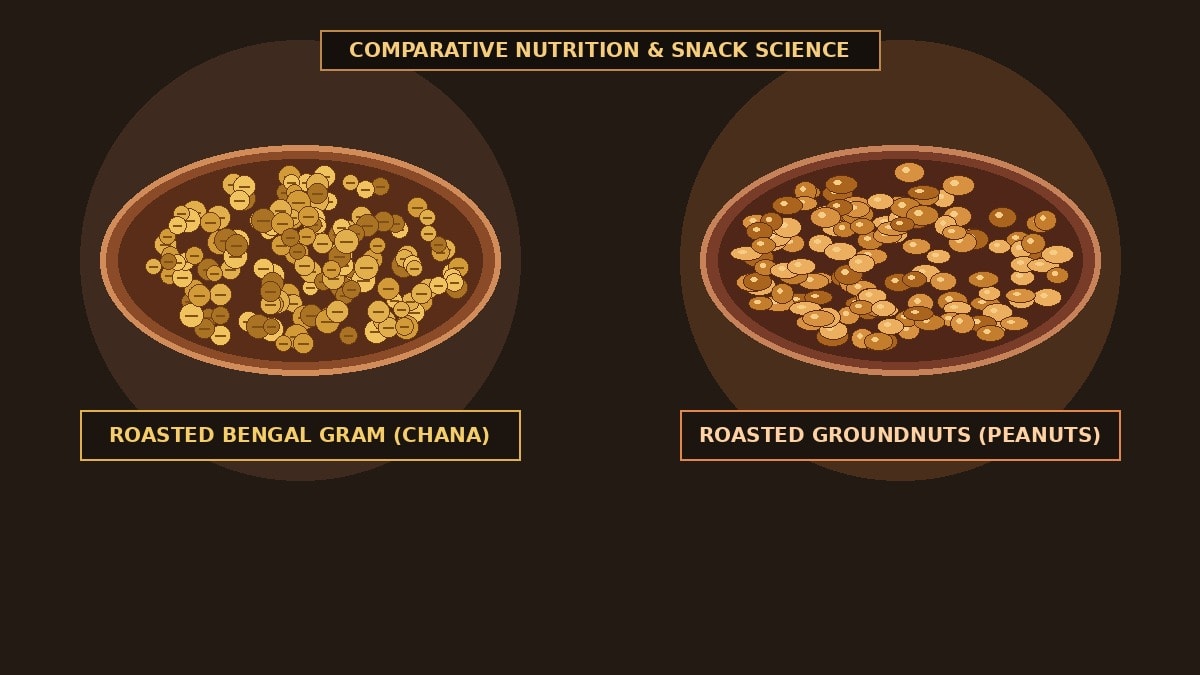
Roasted Chana vs Roasted Peanuts: Which Belongs on Your Evening Snacking Table?
Both hot-air roasted Chana (Bengal Gram, Cicer arietinum) and hot-air roasted Peanuts (Groundnut, Arachis hypogaea) are foundational pillars of authentic Indian snacking and clean evening chakhna. However, they serve distinctly different functional and nutritional roles based on their botanical origin, macronutrient density, and calorie profile.
Choose Roasted Chana if your primary goal is high dietary fiber (~16.8g per 100g), ultra-low fat content (~5.2g per 100g), moderate protein (~18.6g–22.5g), and lower total calories (~360 kcal/100g) for weight management, digestive health, or light tea-time snacking. Choose Roasted Peanuts if you require higher total plant protein (~25.8g per 100g), healthy monounsaturated and polyunsaturated fatty acids (~49.2g per 100g), rich niacin and vitamin E, and calorie-dense, long-lasting energy (~567 kcal/100g) for active workdays, workouts, or hunger control.
For the ideal daily routine, combine both: enjoy crisp roasted chana during light afternoon tea breaks and roasted peanuts during active morning work blocks or social evening chakhna gatherings.
“Roasted Chana provides high fiber and low-fat lightness (~360 kcal/100g), whereas Roasted Peanuts offer higher protein, healthy lipids, and nutrient-dense satiety (~567 kcal/100g).”
Botanical Origins & Food Matrix: Legume Granule vs Oilseed Cotyledon
Understanding the nutritional divergence between roasted chana and roasted peanuts begins with their biological classification and cell structure:
• Bengal Gram / Roasted Chana (Cicer arietinum): Chana is a true pulse (legume seed). Its inner endosperm consists of tightly packed starch granules embedded within a dense protein matrix, surrounded by a thick, fiber-rich seed coat (husk). During hot-air roasting, the moisture within the starch granules expands rapidly, causing the starch to gelatinize and burst the seed coat into a light, airy, crisp texture without requiring added frying oil.
• Groundnut / Roasted Peanut (Arachis hypogaea): Peanuts are subterranean oilseeds. The kernel consists of two thick cotyledons loaded with lipid bodies (spherosomes) containing oleic and linoleic fatty acids alongside storage protein bodies (arachin and conarachin). Dry hot-air roasting at 140°C–160°C roasts the oilseed uniformly, releasing rich pyrazine aromatic compounds while preserving structural cell integrity.
“Chana relies on gelatinized starch and fiber structures for its crisp bite, whereas Peanuts store energy in rich lipid bodies and dense storage proteins.”
Macronutrient Breakdown: ICMR-NIN Comparative Science Table
According to the Indian Food Composition Tables (IFCT) published by ICMR-NIN (National Institute of Nutrition), 100g of dry-roasted chana and dry-roasted peanuts present the following nutritional profiles:
• Protein Density: Roasted Peanuts deliver ~25.8g of plant protein per 100g, compared to ~18.6g–22.5g in Roasted Chana. Peanuts contain rich reserves of arginine, whereas Chana provides a well-balanced pulse protein profile rich in lysine.
• Dietary Fiber: Roasted Chana dominates in dietary fiber, offering ~16.8g per 100g (both soluble and insoluble fiber) compared to ~8.5g in Roasted Peanuts. This high fiber fraction slows gastric emptying and promotes gut microbiome health.
• Lipid Profile & Calorie Density: Roasted Peanuts contain ~49.2g of lipids per 100g (over 80% heart-healthy MUFA and PUFA), resulting in ~567 kcal/100g. Roasted Chana contains only ~5.2g of total fat, resulting in a lighter ~360 kcal/100g.
• Glycemic Index (GI): Both snacks feature ultra-low glycemic indices—GI ~14 for roasted peanuts and GI ~28–32 for roasted chana—preventing rapid postprandial blood sugar spikes.
“Roasted peanuts supply higher protein and healthy fats, whereas roasted chana offers double the dietary fiber with less than one-tenth the fat content.”
Satiety Mechanics: Fiber-Driven Satiety vs Lipid-Driven Fullness
Both snacks excel at curbing appetite between meals, but operate through distinct physiological satiety pathways:
• Fiber-Driven Satiety (Roasted Chana): The abundant dietary fiber in roasted chana absorbs water in the stomach, forming a viscous gel matrix. This expands gastric volume and triggers stretch receptors that signal fullness to the brain (leptin response). Because chana is low in fat, it provides long satiety per calorie, making it ideal for calorie-restricted diets.
• Lipid-Driven Fullness & CCK Release (Roasted Peanuts): The healthy monounsaturated fats in roasted peanuts enter the duodenum, stimulating the secretion of cholecystokinin (CCK) and peptide YY (PYY)—gut hormones that slow intestinal motility and suppress hunger for 3 to 5 hours.
Evening Tea-Time Chakhna & Flavour Pairings: Hing Jeera Chana & Masala Peanuts
In Indian tea-time culture (4 PM to 7 PM), snacks must complement spiced masala chai or evening beverages without overwhelming digestion:
• Hing Jeera Roasted Chana: Roasted chana combined with roasted cumin (jeera), asafoetida (hing), black salt, and dry mango powder (amchur) creates a light, digestive snack. Hing and jeera neutralize intestinal gas, while chana provides a crisp, satisfying crunch.
• Masala Roasted Peanuts: Hot-air roasted peanuts seasoned with chatpata masala, red chili, and amchur complement strong CTC chai, filter coffee, or cold evening drinks, offering a rich, savory mouthfeel.
• Daily Combination Chakhna: Mixing equal parts roasted chana and roasted peanuts creates the ultimate balanced snack mix—combining chana's fiber and crisp lightness with peanuts' protein and rich nuttiness.
“Combining roasted chana with roasted peanuts creates an ideal balanced evening snack—pairing light fiber crunch with rich protein nuttiness.”
FSSAI Food Safety Standards: Zero Trans Fats & Aflatoxin Compliance
To ensure premium safety and clean-label integrity, BN BundleNuts adheres to rigorous FSSAI food safety protocols:
• Continuous Hot-Air Dry Roasting: Unlike roadside vendors who fry chana or peanuts in re-used commercial oil, BN BundleNuts uses oil-free hot-air roasting, guaranteeing 0% trans fats and zero heavy oil residue.
• Aflatoxin & Food Safety Testing: Raw groundnuts and Bengal gram undergo moisture monitoring and laboratory testing to ensure complete absence of aflatoxins (Aspergillus flavus molds) and heavy metals.
• Clean Ingredient Integrity: Seasoned exclusively with natural Indian spices, rock salt, and amchur—free from synthetic MSG, artificial colorants, or palm oil.
Frequently Asked Questions About Roasted Chana vs Roasted Peanuts
Q: Is roasted chana better than roasted peanuts for weight loss? Yes. Roasted chana has significantly lower calorie density (~360 kcal vs ~567 kcal per 100g) and almost double the dietary fiber (16.8g vs 8.5g), making it easier to maintain a calorie deficit while remaining full.
Q: Can I eat both roasted chana and roasted peanuts every day? Absolultely. Consuming 30g to 50g of a mixed roasted chana and peanut blend daily delivers an optimal balance of plant protein, dietary fiber, healthy lipids, iron, and magnesium without digestive heaviness.
Q: Which snack has a lower glycemic index? Both have exceptionally low glycemic indices (Roasted Peanuts ~14, Roasted Chana ~28–32), making both excellent choices for individuals managing blood sugar levels or diabetes.
Q: Why choose BN BundleNuts over loose roadside roasted chana and peanuts? Roadside loose snacks are frequently exposed to atmospheric moisture, urban dust, and re-used frying oils. BN BundleNuts provides continuous hot-air dry roasting, nitrogen-flushed protective packaging, guaranteed zero trans fats, and strict FSSAI compliance.