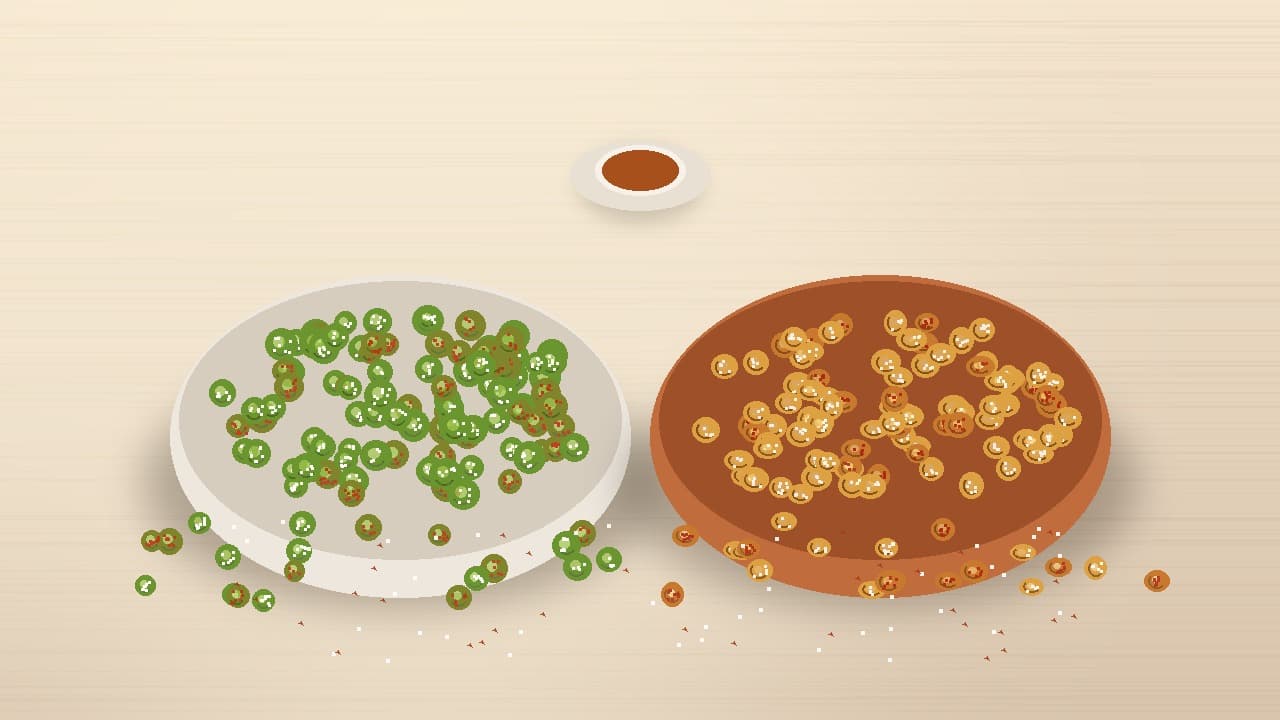
Quick Answer: Which Roasted Legume Wins for Daily Snacking?
Both dry-roasted green peas (Matar) and dry-roasted Bengal gram (Chana) represent top-tier, oil-free vegetarian pulse snacks in Indian culinary heritage. However, their biochemical profiles cater to slightly different daily snacking requirements.
Choose Roasted Green Peas if your priority is a lighter, lower-fat crunchy snack (~3.2g fat/100g) with slightly higher raw plant protein density (~21.5g protein/100g) and rich soluble dietary fiber that complements evening tea or office breaks without heaviness.
Choose Roasted Chana (Bengal Gram) if your goal is maximum prolonged satiety and digestive gut health, driven by higher overall dietary fiber (~16.8g/100g), exceptional resistant starch content, and a lower Glycemic Index (GI ~28) that delivers slow-release energy throughout long work sessions.
“Roasted green peas deliver ultra-light plant protein with minimal lipids (~3.2g/100g), whereas roasted chana excels in dietary fiber density (~16.8g/100g) and long-lasting postprandial satiety.”
Introduction: The Indian Pulse-Based Snacking Revolution
Across India, evening tea time (4:00 PM to 6:00 PM) has long been dominated by high-calorie, deep-fried namkeen such as bhujia, mathri, and fried samosas. However, modern FMCG consumer trends show a dramatic shift toward oil-free, dry-roasted pulse snacks.
Whole legumes like green peas (Pisum sativum) and Bengal gram (Cicer arietinum) undergo thermal hot-air roasting to transform raw agricultural grains into airy, highly palatable, shelf-stable crunch snacks without chemical preservatives or excessive oil immersion.
In this guide, the BundleNuts FMCG Food Science Desk examines the plant protein ratios, dietary fiber fractions, glycemic loads, roasting physics, and sensory mechanics of roasted green peas versus roasted chana to help consumers make informed daily snacking decisions.
Botanical Foundations: Green Peas (Pisum sativum) vs Bengal Gram (Cicer arietinum)
Green peas belong to the Fabaceae botanical family. Harvested as mature dry peas, they undergo controlled dehydration before thermal expansion. When dry-roasted under controlled hot-air currents (160°C – 180°C), internal moisture rapidly converts to steam, expanding the starch matrix and creating a crisp, lightweight cell structure.
Bengal gram (Chana), specifically Desi chickpea varieties, features a thick seed coat rich in polyphenols and tannins. When dry-roasted in hot sand or continuous rotary hot-air roasters, the starch granules gelatinize internally while the outer hull loosens, resulting in iconic cracked roasted chana with deep earthy aromas.
Neither process requires deep oil frying. By utilizing hot-air thermal transfer, both snacks remain intrinsically low in total lipids, preserving the intact amino acid profiles and complex carbohydrate matrices.
“Hot-air dry roasting uses steam pressure and conductive thermal transfer to puff legumes naturally, eliminating the need for oil baths.”
Macronutrient Breakdown: Plant Protein Ratios and Lipid Profiles
According to the ICMR-NIN Indian Food Composition Tables (IFCT 2017), dry-roasted green peas provide approximately 21.5 grams of plant-based protein per 100g portion. This protein matrix is rich in essential amino acids, particularly lysine and glutamic acid, making it an excellent complementary protein source when paired with grains.
Dry-roasted chana delivers approximately 20.4 grams of plant protein per 100g portion. While slightly lower in total protein density than green peas, roasted chana possesses a remarkably balanced essential amino acid score with significant concentrations of arginine and leucine.
Where the two legumes diverge significantly is naturally occurring lipid content. Dry-roasted green peas contain only 3.2 grams of natural fat per 100g, whereas roasted chana contains approximately 5.8 grams per 100g. Both fat profiles consist primarily of polyunsaturated and monounsaturated fatty acids with zero trans-fats.
Dietary Fiber, Gut Health, and Glycemic Response
Dietary fiber is essential for regulating digestion, nourishing beneficial gut microflora, and modulating blood glucose uptake. Roasted Bengal gram leads with ~16.8g of total dietary fiber per 100g, comprising high levels of insoluble cellulose and resistant starch Type-3 (RS3).
This high insoluble fiber structure gives roasted chana an exceptionally low Glycemic Index (GI ~28). Consuming a 30g-40g serving of roasted chana leads to a slow, measured release of glucose into the bloodstream, preventing late-afternoon energy crashes.
Roasted green peas provide ~14.5g of dietary fiber per 100g, with a higher proportion of soluble pectin and fermentable hemicelluloses. With a Glycemic Index of ~32, roasted green peas support smooth digestion and promote short-chain fatty acid (SCFA) production in the colon.
“Both roasted chana (GI 28) and green peas (GI 32) qualify as low-glycemic snacks that prevent blood sugar spikes and sustain mental focus.”
Thermal Roasting Physics vs Deep Frying: Eliminating Oil & Trans-Fats
Commercial deep frying submerges snacks in oil baths kept at 180°C–200°C. Over extended commercial production cycles, oil oxidation generates free fatty acids, acrolein, and harmful trans-fat compounds, while dramatically inflating calorie density (often exceeding 550 kcal/100g).
BundleNuts utilizes hot-air dry-roasting technology. High-velocity air currents heat the moisture inside green peas and chana, expanding the cellular structure internally.
This hot-air expansion results in a light, satisfying crunch at ~380 kcal/100g without saturated trans-fats, keeping the product clean, digestible, and suitable for daily consumption.
Sensory Profile, Crunch Mechanics & Tea-Time Chakhna Occasions
Roasted Green Peas present a distinct light, airy crunch with subtle naturally sweet undertones. When seasoned with Indian spices like Hing (asafoetida), Jeera (cumin), or Chaat Masala, they deliver an energetic, vibrant crunch that pairs remarkably well with hot Masala Chai.
Roasted Chana offers a firmer, denser, nuttier bite with deep toasted grain notes. It provides a hearty, filling texture that serves as a satisfying evening chakhna during workday desk breaks or family gatherings.
For variety, alternating between roasted green peas and roasted chana ensures balanced micronutrient intake while preventing taste fatigue.
Practical Buying, Storage, and Moisture Control Guidelines
Because dry-roasted legumes rely on a crisp starch-protein matrix, exposure to atmospheric humidity is their main quality threat. Water vapor rapidly softens the cellular walls, causing loss of crunch (staling).
Store opened packs in airtight glass or high-grade food-safe plastic containers away from direct sunlight and stove heat.
Select nitrogen-flushed, multi-layer barrier pouches (such as BundleNuts ziplock packs) that protect against oxygen degradation and moisture ingress, preserving factory-fresh crunch for months.
BundleNuts Recommendation & Daily Chakhna Integration
At BN BundleNuts, our Daily Chakhna philosophy centers on delivering authentic Indian flavours with modern clean-label roasting standards. We refuse to compromise on oil quality or rely on artificial flavor enhancers.
Our Salted Roasted Green Peas and Masala Roasted Green Peas offer a vibrant, low-fat crunch, while our Salted Roasted Channa and Masala Roasted Channa deliver deep, fiber-rich satisfaction.
Explore our Daily Chakhna category to discover retail and family packs designed for office desks, evening tea breaks, and family sharing.
“BundleNuts Daily Chakhna range uses 100% hot-air dry-roasting for clean, oil-free snacking without hidden fats or chemical additives.”
Frequently Asked Questions (FAQs)
Q1: Which has more protein, roasted green peas or roasted chana? Dry-roasted green peas have slightly higher raw protein density (~21.5g per 100g) compared to roasted chana (~20.4g per 100g). Both are excellent plant protein sources.
Q2: Is roasted green peas good for weight management? Yes. Roasted green peas are naturally low in fat (~3.2g/100g) and rich in dietary fiber (~14.5g/100g), providing a low-calorie, high-satiety crunchy alternative to deep-fried namkeen.
Q3: Are these snacks suitable for diabetics? Yes. Both roasted green peas (GI ~32) and roasted chana (GI ~28) have low glycemic index values, resulting in slow glucose release without causing rapid blood sugar spikes.
Q4: Do BundleNuts green peas and chana contain added oil? No. BundleNuts green peas and chana are prepared using dry hot-air roasting technology, ensuring an oil-free, clean-label snacking experience.