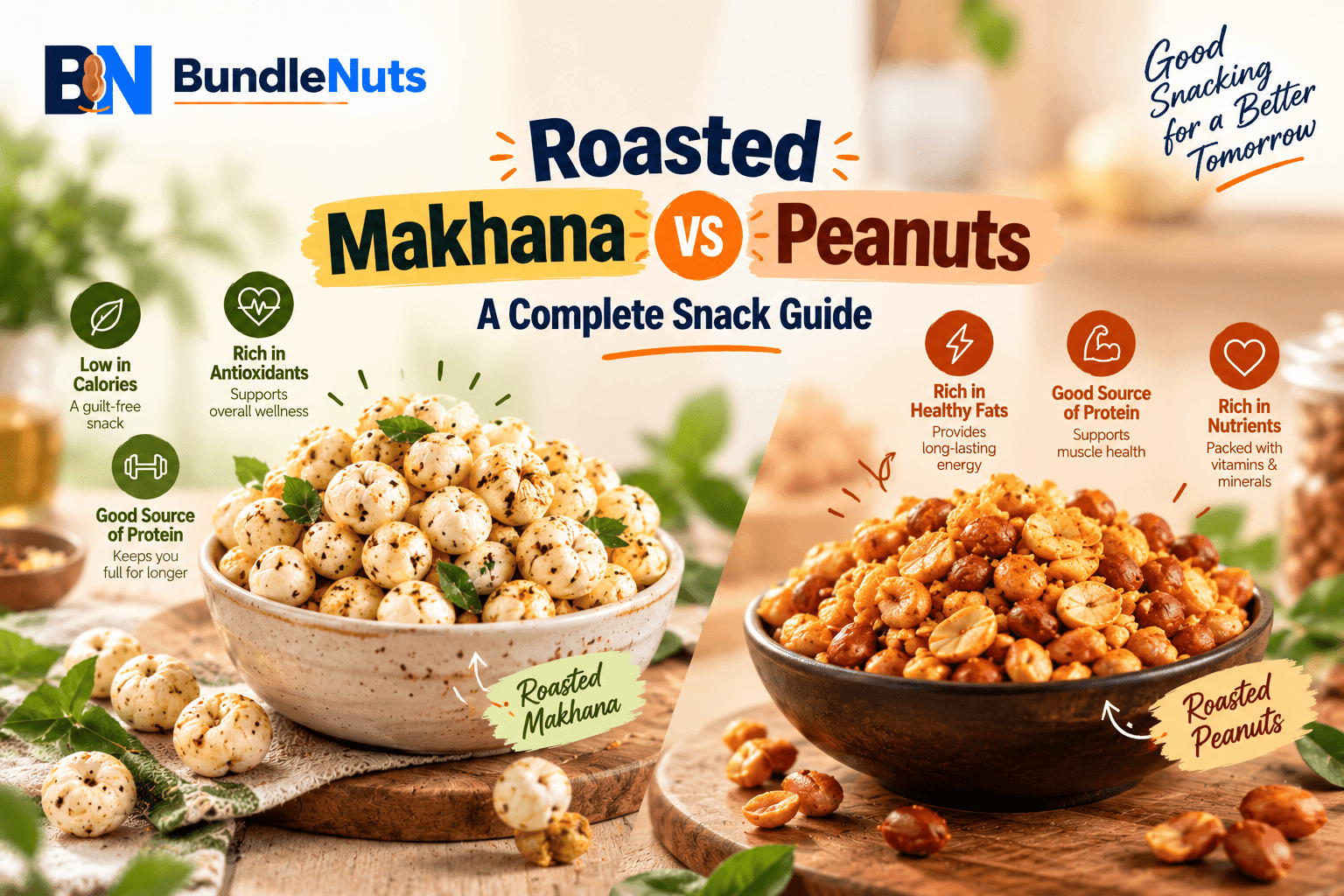
Roasted Makhana vs Roasted Peanuts: Which Belongs on Your Evening Table?
Choosing between roasted makhana (puffed water lily seeds / Euryale ferox) and roasted peanuts (bold Java / TJ groundnuts) depends on your caloric targets, macronutrient requirements, and snacking context. Both dry-roasted snacks are vastly superior to traditional deep-fried namkeen mixtures and potato chips because they are processed without deep oil bath submersion, leaving your fingers completely non-greasy during office work and home leisure.
Roasted makhana is the ultimate low-calorie, high-volume snack. Containing under 350 kcal and less than 5g of total fat per 100g, makhana delivers remarkable volumetric satiety—a 30g portion fills a large bowl while providing under 120 calories along with bioavailable calcium, magnesium, and resistant starch. In contrast, roasted peanuts represent a concentrated, protein-dense energy powerhouse. Delivering 25g of plant protein and 48g of heart-healthy monounsaturated fatty acids (MUFA) per 100g, peanuts offer prolonged satiety, muscle-building amino acids, and steady cognitive stamina for intense workday focus.
“Opt for roasted makhana when aiming for weight management and high-volume, low-calorie snacking; choose roasted peanuts for high plant protein, healthy monounsaturated lipids, and long-lasting energy.”
Botanical Origins & Thermal Processing: Steam Expansion vs Hot-Air Roasting
Understanding the structural transformations of makhana and peanuts during commercial processing explains their contrasting physical and nutritional properties:
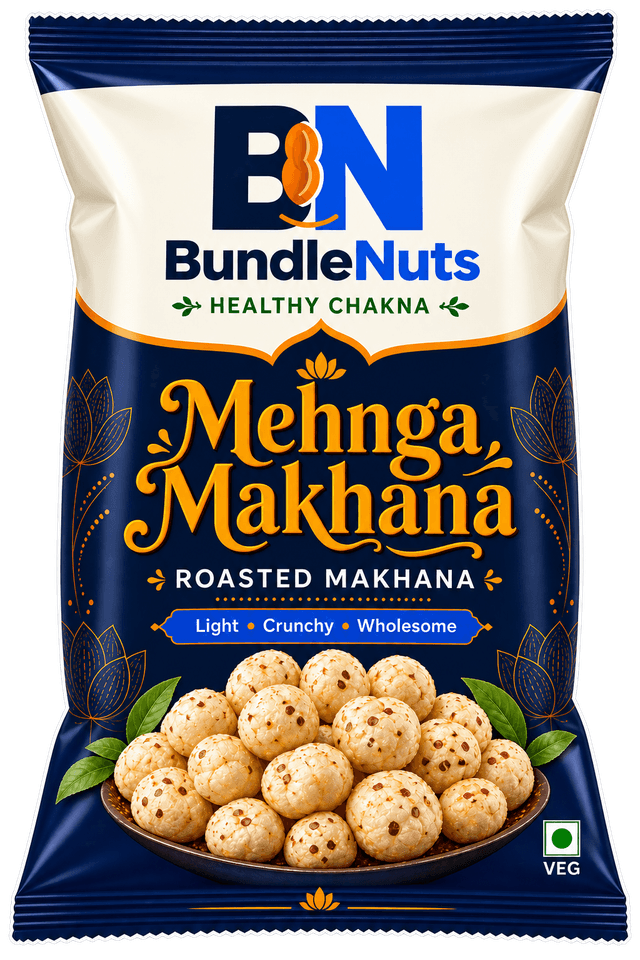
• Makhana Steam Popping (Euryale ferox): Makhana seeds are harvested from aquatic water lily plants in wetlands. High-temperature roasting in specialized pans causes internal kernel moisture to vaporize instantaneously into steam. This steam explosion pops open the seed coat, expanding the starch matrix into an ultra-light, porous structure. At BN BundleNuts, our Healthy Chakhna makhana undergoes secondary hot-air dry roasting to achieve a water activity below aw 0.35, locking in an acoustic crunch with zero trans fats.
• Peanut Thermal Roasting (Arachis hypogaea): Peanuts are underground legume pods rich in natural oils. Continuous hot-air dry roasting at 140°C–160°C activates Maillard browning reactions between amino acids and natural sugars, developing rich, golden nutty aromas. Spices are applied with a microscopic edible oil mist rather than continuous deep frying, keeping total fat pure and non-greasy.
“Makhana leverages internal steam popping to create lightweight, airy volume, whereas dry roasting peanuts cooks natural kernel lipids to unlock golden flavor.”
Calorie Density & Volumetric Satiety: The Psychology of Portion Size
A critical factor in daily snacking management is 'volumetric satiety'—the physiological perception of fullness driven by the visual and physical volume of food consumed:
• The Makhana Volume Advantage: Because popped makhana consists of expanded starch cells filled with trapped air, a standard 30g serving occupies roughly 1.5 cups (over 350ml in volume) while delivering only ~115 kcal. This large visual portion tricks the brain's satiety centers, curbing subconscious hunger during late-night movie watching or desk working without accumulating heavy calories.
• The Peanut Energy Density Advantage: In contrast, a 30g serving of roasted peanuts occupies about 0.25 cups (~60ml in volume) but supplies ~170 kcal and 7.5g of plant protein. While physically compact, the high lipid and protein content in peanuts triggers satiety gut hormones (CCK and PYY), delaying gastric emptying and sustaining metabolic energy for 3 to 4 hours.
Macronutrient Breakdown: Plant Protein, Healthy Lipids, Fiber, and Minerals
Evaluating 100g of dry-roasted makhana versus dry-roasted peanuts reveals distinct functional nutritional profiles:
• Plant Protein Density: Peanuts supply 25g of bioavailable plant protein per 100g (over 10g per 40g serving), making them one of the richest natural legume protein sources. Makhana provides ~9.7g of protein per 100g (~3g per 30g bowl).
• Lipid Profile & Heart Health: Peanuts contain ~48g of total fat per 100g, but over 80% of these lipids consist of heart-healthy Monounsaturated (Oleic Acid) and Polyunsaturated (Linoleic Acid) fatty acids. Makhana contains under 3g–5g of fat per 100g, making it virtually lipid-free when dry roasted.
• Micronutrient Wealth: Makhana excels in essential bone minerals, offering 67mg of Calcium and 500mg of Potassium per 100g. Peanuts counter with abundant B-complex vitamins (Niacin B3, Folate B9), Vitamin E, Magnesium, and Zinc.
Digestibility Chemistry & Glycemic Stability: Preventing Midday Energy Slumps
Both snacks demonstrate superior glycemic stability compared to refined wheat biscuits and fried potato chips, but operate through different digestive mechanisms:
• Low Glycemic Index (GI): Both roasted makhana (GI ~45) and roasted peanuts (GI ~14) fall into the low-GI spectrum. Eating either snack during the 4:00 PM tea break prevents sharp insulin spikes and subsequent blood sugar crashes.
• Resistant Starch in Makhana: Makhana contains resistant starch that escapes early small intestine digestion, traveling to the large intestine where colonic microbiota ferment it into beneficial short-chain fatty acids (SCFAs like butyrate). This nourishes the gut lining and supports metabolic balance.
• Carminative Spice Enhancement: Pairing roasted peanuts or makhana with digestion-friendly Indian spices—such as Asafoetida (Hing), Cumin (Jeera), and Rock Salt—stimulates pancreatic digestive enzymes and facilitates smooth gastrointestinal transit.
“Low glycemic indices and natural digestive fiber in both snacks preserve steady cognitive alertness without afternoon post-snack lethargy.”
Matching Makhana and Peanuts to Daily Workday & Social Moments
Incorporate clean, crunchy makhana and peanuts into your daily routine across these key moments:
1. 11:00 AM Mid-Morning Focus Boost: Keep a 70g pouch of Classic Salted Roasted Peanuts at your desk for clean protein that sustains mental focus until lunch.
2. 4:00 PM Office Tea-Time Ritual: Pair Salted Roasted Makhana or Hing Jeera Peanuts with warm ginger chai. The non-greasy crunch balances tea tannins without staining laptop keyboards.
3. Evening Chakhna & Social Gatherings: Serve a dual platter featuring Peri Peri Makhana alongside Masala Roasted Peanuts for a zesty, oil-free Indian chakhna spread.
4. Late-Night Study & Movie Snacking: Opt for a bowl of Salted Roasted Makhana to satisfy late-night crunch cravings while keeping total caloric intake well within daily limits.
Explore the BN BundleNuts Daily & Healthy Chakhna Ranges
At BN BundleNuts, our Chakhna series celebrates authentic Indian roasting traditions and uncompromised food safety:
• Salted Roasted Makhana: Lightly salted puffed foxnuts for mindful desk snacking. Available at /products/healthy-chakhna/salted-roasted-makhana.
• Peri Peri Makhana: Zesty, spicy roasted makhana tossed in fiery bird's eye chili seasoning. Available at /products/healthy-chakhna/peri-peri-makhana.
• Salted Roasted Peanuts: Crisp, golden hot-air roasted peanuts seasoned with rock salt. Available at /products/daily-chakhna/salted-roasted-peanuts.
• Spiced Peanut Range: Explore our flavor-packed options including /products/daily-chakhna/masala-roasted-peanuts, /products/daily-chakhna/hing-jeera-peanuts, and /products/daily-chakhna/chilli-garlic-peanuts.
For further reading on clean Indian snacking, explore our comprehensive guides on Roasted Makhana vs Potato Chips (/blog/makhana-vs-potato-chips-roasted-snack-guide), Roasted Peanuts vs Raw Peanuts Digestibility Guide (/blog/roasted-peanuts-vs-raw-peanuts-digestibility-guide), How to Choose Roasted Peanuts for Office & Tea-Time Snacking (/blog/how-to-choose-roasted-peanuts-office-tea-time-snacking), and Peri Peri Makhana vs Salted Makhana Snack Guide (/blog/peri-peri-makhana-vs-salted-makhana-snack-guide).
Roasted Makhana vs Roasted Peanuts FAQs
Q: Is roasted makhana better than roasted peanuts for weight loss? A: Roasted makhana has a lower calorie density (~350 kcal/100g vs ~567 kcal/100g) and higher volume per gram, making it easier to eat a large bowl for under 120 calories. However, roasted peanuts provide higher plant protein and healthy fats that keep you full for longer.
Q: Do BundleNuts makhana and peanuts contain added palm oil? A: No! BundleNuts uses 100% hot-air dry roasting instead of continuous deep oil frying. A microscopic edible oil mist is used solely to adhere ground spices to the kernels.
Q: Can I mix makhana and peanuts together in a custom trail mix? A: Absolutely! Combining two parts roasted makhana with one part roasted peanuts creates an ideal balanced snack delivering light volumetric crunch alongside bioavailable protein and healthy MUFA lipids.