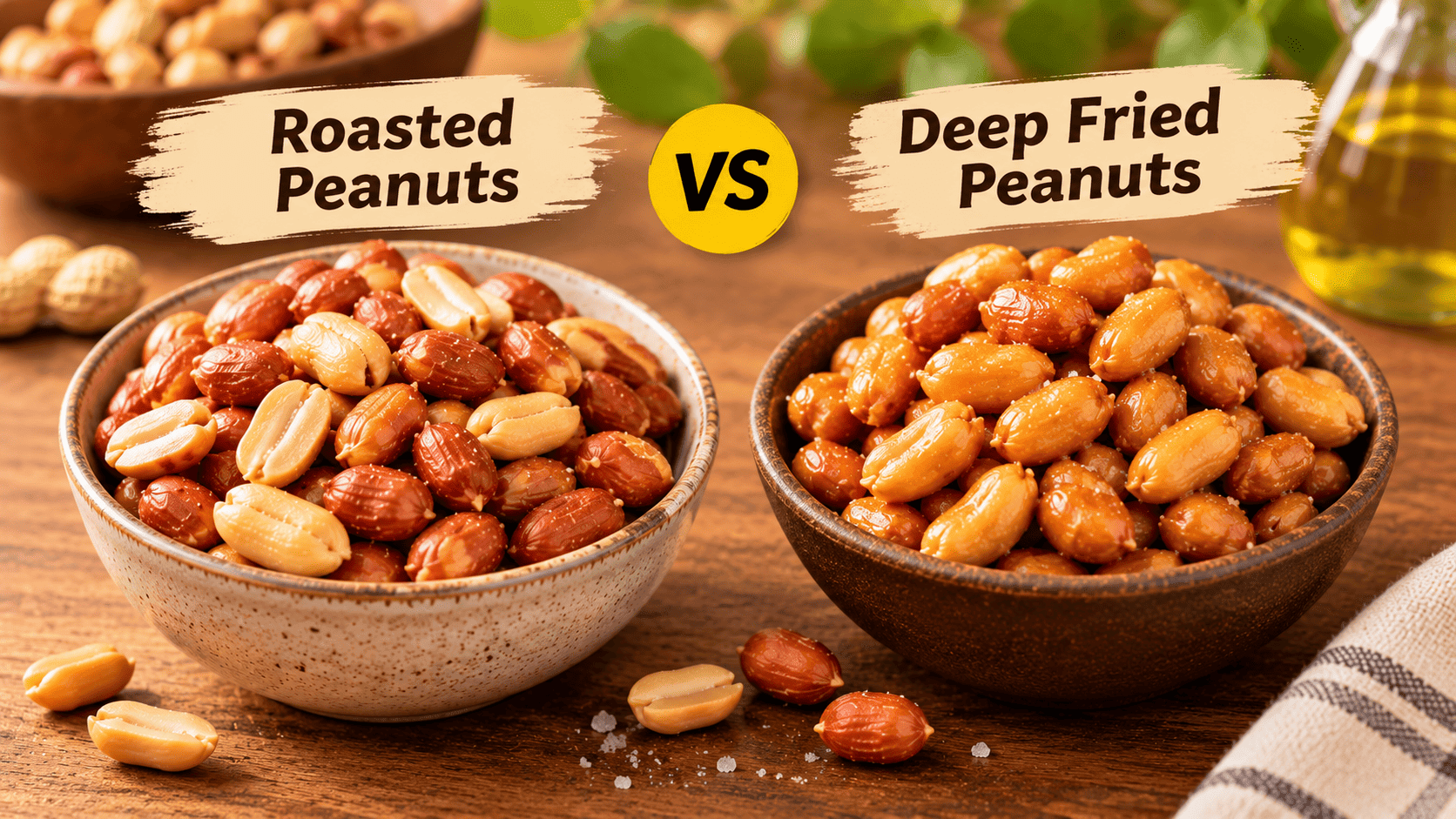
Hot-Air Roasted Peanuts vs Deep-Fried Peanuts: Which Belongs on Your Daily Table?
Hot-air dry-roasted peanuts (Arachis hypogaea) are fundamentally superior to commercial deep-fried peanuts for daily workday, office, and evening tea-time snacking. Traditional mass-market fried peanuts submerge groundnut kernels in boiling palm or vegetable oil at 180°C. This process causes boiling oil to infiltrate internal cellular voids, saturating the peanuts with up to 35% total fat, high saturated fatty acids, and oxidized lipid thermal breakdown products that leave heavy red grease on fingers, keyboards, and clothing.
In contrast, BN BundleNuts Hot-Air Roasted Peanuts undergo continuous dry roasting in circulating thermal air at 140°C–160°C without oil bath submersion. This process preserves natural heart-healthy monounsaturated fatty acids (oleic acid) and bioavailable plant protein (25g per 100g), eliminates trans fats, and utilizes a microscopic edible oil mist to adhere ground spices (rock salt, amchur, hing, jeera, or chilli garlic) firmly to kernel skins. The result is an acoustic crunch that keeps your fingers 100% clean while working at desk setups and touchscreens.
“Continuous hot-air roasting preserves natural groundnut lipids and bioavailable plant protein while eliminating oil saturation and toxic thermal oxidation products.”
Thermal Processing Mechanics: Hot-Air Circulation vs Deep Oil Submersion
The stark nutritional and sensory difference between roasted and fried peanuts stems directly from their physical and thermal processing mechanics:
• Deep Oil Frying Submersion (Commercial Mass-Market): Raw peanut kernels contain 6% to 8% internal moisture. When dropped into continuous oil fryers filled with commercial palm or rice bran oil at 175°C–190°C, internal moisture vaporizes rapidly into steam. Boiling oil instantly rushes into the evacuated cellular voids, saturating the nut matrix. Consequently, fried peanuts absorb 10g to 15g of extra commercial frying oil per 100g, raising total calorie density to over 620 kcal per 100g.
• Precision Hot-Air Dry Roasting (BN BundleNuts): Raw bold Java or TJ peanut kernels pass through multi-zone thermal hot-air roasters at 140°C–160°C. Circulating thermal air cooks the kernels evenly, triggering Maillard browning reactions between natural amino acids and reducing sugars. This unlocks rich pyrazine aromas and golden color without adding external frying oil. Water activity drops below aw 0.35, locking in crispness naturally.
“Deep frying replaces internal moisture voids with boiling commercial oil, whereas hot-air roasting evaporates moisture using circulating thermal air to create a light, clean crunch.”
Lipid Oxidation, Total Polar Compounds (TPC), and Trans-Fat Dynamics
To evaluate long-term dietary health impact, FMCG food scientists examine oil degradation chemistry during high-heat frying:
• Oil Re-use & Total Polar Compounds (TPC): In commercial frying operations, oil baths are heated continuously for hours or days. High heat in the presence of atmospheric oxygen and food moisture causes thermal hydrolysis, oxidation, and polymerization—forming toxic Total Polar Compounds (TPC), free fatty acids, and cyclic monomers. FSSAI food safety regulations mandate discarding commercial frying oil when TPC exceeds 25%. Continuous ingestion of oxidized frying oil causes digestive inflammation and oxidative cellular stress.
• Trans-Fat Formation & Saturated Fat Overhead: High-temperature oil bath frying converts natural unsaturated cis-fatty acids into harmful trans-fatty acid isomers. Furthermore, commercial frying relies heavily on saturated palm oil, increasing saturated fat content by up to 300% compared to dry-roasted groundnuts.
• Unadulterated Oleic & Linoleic Protection: Hot-air dry roasting preserves the unadulterated lipid profile of bold groundnut kernels—consisting of over 80% heart-healthy Monounsaturated Fatty Acids (MUFA, oleic acid) and Polyunsaturated Fatty Acids (PUFA, linoleic acid) that support cardiovascular health.
Micro-Mist Spice Adhesion Mechanics: Zero Grease for Keyboard & Desk Snacking
A major challenge in workplace and desk-side snacking is avoiding oil-stained keyboards, touchscreens, and paperwork:
• The Greasy Finger Problem (Fried Peanuts): Fried peanuts rely on residual surface frying oil to stick ground spice powders to the nut skin. As consumers eat, this thick red oil layer rubs off on fingertips, staining laptop keyboards, smartphone screens, and official documents.
• Micro-Mist Spray Adhesion (BN BundleNuts): At BN BundleNuts, spices adhere through a specialized micro-mist technology. Immediately after hot-air roasting, hot kernels are passed under a microscopic atomizer that sprays a fine edible oil mist (less than 1% by weight). Ground Indian spices—such as rock salt, amchur, roasted cumin, asafoetida, and dry red chili—bind tightly to kernel surfaces. The result is a bold, chatpata flavor delivery that leaves fingers completely non-greasy.
“Micro-atomized oil misting binds authentic ground spices to hot-air roasted peanuts without drenching nuts in heavy frying oil.”
Macronutrient Head-to-Head: Hot-Air Roasted vs Deep-Fried Peanuts
Evaluating a standard 35g single-serve tea-time portion reveals clear nutritional contrasts:
• Total Calories: 35g of hot-air roasted peanuts supplies ~198 kcal versus ~225 kcal in equal weight deep-fried peanuts.
• Total Fat & Saturated Fat: Hot-air roasted peanuts contain ~16.8g fat (under 2.5g saturated fat), whereas fried peanuts contain ~22g total fat (up to 8.5g saturated fat from palm oil).
• Plant Protein & L-Arginine: Both varieties supply 8.8g of plant protein per 35g serving (25g/100g), rich in L-arginine to support vascular circulation and muscle stamina.
• Glycemic Response: With a low Glycemic Index (GI ~14), hot-air roasted peanuts release glucose gradually, preventing afternoon blood sugar spikes and cognitive energy slumps.
Matching Hot-Air Roasted Peanuts to Workday & Social Moments
Incorporate clean, crunchy hot-air roasted peanuts into your daily routine across these key moments:
1. 11:00 AM Mid-Morning Desk Fuel: Snack on a 35g pouch of Classic Salted Roasted Peanuts for clean plant protein and healthy MUFA lipids to sustain focus until lunch.
2. 4:00 PM Office Cutting Chai Ritual: Pair Hing Jeera Roasted Peanuts or Masala Roasted Peanuts with warm ginger chai. The non-greasy crunch balances tea tannins perfectly without leaving oil stains on keyboards.
3. Evening Chakhna & Social Spreads: Serve a platter featuring Chilli Garlic Roasted Peanuts alongside Salted Roasted Chana and Diet-Style Roasted Mixture for a zesty, oil-free Indian chakhna spread.
4. Travel & Car Console Fuel: Keep 70g pouches in car consoles or laptop bags for instant, non-perishable nutrition during daily commutes.
Explore the BN BundleNuts Daily Chakhna Peanut Lineup
At BN BundleNuts, our Daily Chakhna peanut series celebrates authentic Indian roasting traditions and uncompromised food safety:
• Salted Roasted Peanuts: Golden hot-air roasted peanuts seasoned with rock salt. Available at /products/daily-chakhna/salted-roasted-peanuts.
• Masala Roasted Peanuts: Zesty roasted peanuts tossed in authentic chatpata Indian spices. Available at /products/daily-chakhna/masala-roasted-peanuts.
• Hing Jeera Peanuts: Digestion-friendly roasted peanuts infused with asafoetida and roasted cumin. Available at /products/daily-chakhna/hing-jeera-peanuts.
• Chilli Garlic Peanuts: Fiery roasted peanuts coated in red chili and garlic seasoning. Available at /products/daily-chakhna/chilli-garlic-peanuts.
For further reading on groundnut nutrition and workplace snacking, explore our comprehensive guides on Masala Peanuts vs Salted Peanuts (/blog/masala-peanuts-vs-salted-peanuts-snack-guide), Roasted Peanuts vs Raw Peanuts Digestibility Guide (/blog/roasted-peanuts-vs-raw-peanuts-digestibility-guide), Peanut Butter vs Whole Roasted Peanuts (/blog/peanut-butter-vs-whole-roasted-peanuts-snack-guide), and Roasted Chana vs Roasted Peanuts Guide (/blog/roasted-chana-vs-roasted-peanuts-snack-guide).
Hot-Air Roasted vs Deep-Fried Peanuts FAQs
Q: Do BundleNuts roasted peanuts contain any palm oil or added trans fats? A: No! BN BundleNuts uses 100% hot-air dry roasting instead of continuous oil bath submersion. A microscopic edible oil mist is used solely to adhere ground spices to kernel skins.
Q: Why are deep-fried peanuts greasier on fingers than dry-roasted peanuts? A: Deep frying submerges peanuts in boiling oil at 180°C, causing boiling oil to replace internal water voids. Dry roasting uses circulating hot air to cook kernels without oil immersion.
Q: How do BundleNuts pouches protect roasted peanuts against humidity and sogginess? A: All BundleNuts products are sealed in multilayer metallized aluminum barrier pouches with food-grade nitrogen gas flushing, keeping water activity below aw 0.35 for 6 months.