
Roasted Peanuts vs Roasted Almonds: Which Belongs on Your Daily Snacking Table?
Both hot-air roasted Peanuts (Groundnut, Arachis hypogaea) and hot-air roasted California Almonds (Prunus dulcis) are foundational pillars of clean Indian snacking, everyday desk fuel, and premium chakhna. However, they serve distinctly different physiological, nutritional, and financial roles in a daily diet based on their botanical origin, macronutrient density, and cost-per-gram economics.
Choose Roasted Peanuts if your primary goal is maximum bioavailable plant protein (~25.8g per 100g), high L-arginine for vascular circulation, heart-healthy monounsaturated oleic fatty acids (~49.2g per 100g), and unbeatable cost-per-gram protein economics for high-frequency daily snacking (~567 kcal/100g). Choose Roasted Almonds if you require higher dietary fiber (~12.5g per 100g vs 8.5g in peanuts), exceptional Vitamin E antioxidant protection (~26mg per 100g), rich magnesium and calcium for bone and muscle recovery, and a low glycemic load for mindful, luxury desk snacking.
For an ideal daily routine, combine both: enjoy cost-effective hot-air roasted peanuts during high-frequency morning work blocks or afternoon tea-time chakhna, and savor premium roasted almonds for pre-workout fuel, mindful evening snacking, or festive gifting.
“Roasted Peanuts deliver superior plant protein density (~25.8g/100g) and unbeatable cost-per-gram value, whereas Roasted Almonds offer higher dietary fiber (~12.5g/100g) and rich Vitamin E (~26mg/100g).”
Botanical Origins & Matrix Science: Subterranean Oilseed vs Tree Nut Drupe
Understanding the structural divergence between roasted peanuts and roasted almonds begins with their biological classification and cotyledon architectures:
• Groundnut / Roasted Peanut (Arachis hypogaea): Peanuts are subterranean legumes that mature underground within protective woody pods. The kernel consists of two thick cotyledons packed with lipid bodies (oleosomes) and storage protein bodies (arachin and conarachin). Dry hot-air roasting at 140°C–160°C roasts the oilseed uniformly, activating Maillard browning reactions between natural amino acids and sugars to unlock rich pyrazine aromatic compounds without requiring external frying oil.
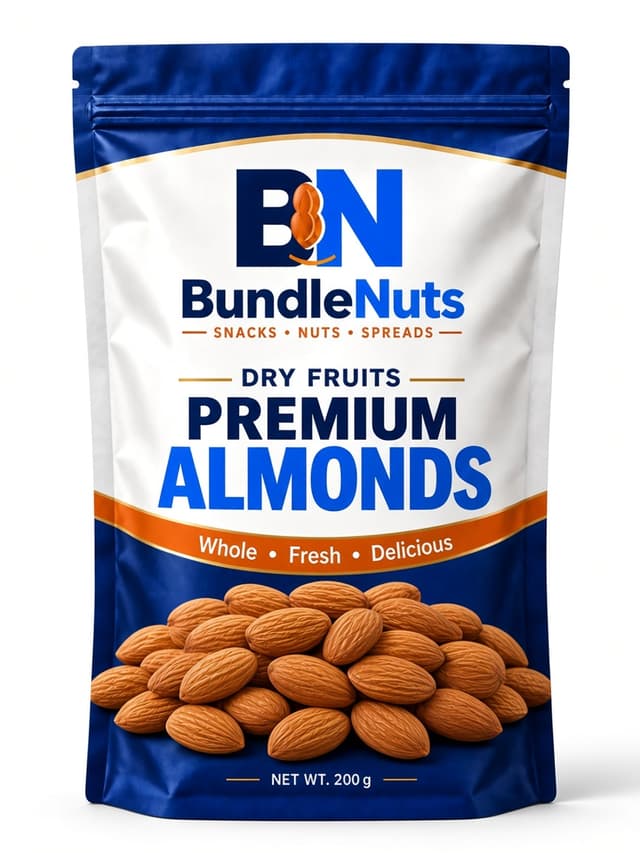
• California Almond (Prunus dulcis): Almonds are tree nut drupes grown in Mediterranean climates. The edible almond kernel is encased in a papery, brown seed coat rich in polyphenolic flavonoids. Inside, the dense cellular matrix stores monounsaturated fatty acids alongside alpha-tocopherol (Vitamin E). Precision hot-air roasting crisp-roasts the almond flesh while preserving the antioxidant integrity of the outer brown skin.
“Peanuts are subterranean legumes packed with storage proteins and pyrazines, while Almonds are tree nut drupes loaded with Vitamin E and skin flavonoids.”
Macronutrient & Micronutrient Comparison: Protein, Lipids, Fiber, and Vitamin E
According to the Indian Food Composition Tables (IFCT) published by ICMR-NIN (National Institute of Nutrition) and USDA food database benchmarks, 100g of dry-roasted peanuts and dry-roasted almonds present the following nutritional profiles:
• Bioavailable Plant Protein: Dry-roasted Peanuts take the lead in total plant protein density, delivering ~25.8g per 100g compared to ~21.2g in California Almonds. Peanuts are especially rich in L-arginine, an essential amino acid that synthesizes nitric oxide for arterial vasodilation and muscle endurance.
• Dietary Fiber & Gut Health: Dry-roasted Almonds dominate in dietary fiber, supplying ~12.5g per 100g (over 40% of daily recommended intake) compared to ~8.5g in Peanuts. Almond fiber consists of insoluble cellulose and pectin that nourish gut microbiota and promote smooth intestinal transit.
• Vitamin E & Micronutrient Wealth: Almonds are an antioxidant superpower, supplying ~26mg of Vitamin E (alpha-tocopherol) per 100g—meeting over 170% of the daily recommended intake to defend cell membranes against free radical damage. Peanuts counter with high Niacin (Vitamin B3, ~12mg/100g) for cellular energy metabolism and Folate (B9).
• Healthy Lipid Spectrum: Both nuts feature heart-healthy lipid profiles dominated by Monounsaturated Fatty Acids (MUFA, oleic acid). Peanuts contain ~49.2g total fat (~567 kcal/100g), while Almonds contain ~49.9g total fat (~579 kcal/100g).
“Peanuts lead in total plant protein and niacin, whereas almonds excel in dietary fiber, magnesium, and Vitamin E.”
Satiety Mechanics & Cost-Per-Gram Economics: High-Frequency Chakhna vs Premium Indulgence
When evaluating daily snacks, consumers must weigh physiological satiety against household snacking budgets:
• Satiety Index & Oral Mastication: Both roasted peanuts and roasted almonds require deliberate oral mastication. Chewing whole crisp nuts triggers salivary amylase and stimulates the gastrointestinal release of satiety hormones (cholecystokinin CCK and PYY), delaying gastric emptying for 3 to 4 hours.
• Cost-Per-Gram Protein Economics: From a financial perspective, roasted peanuts offer three times the bioavailable protein per rupee compared to imported tree nuts. This makes roasted peanuts the ultimate high-frequency, budget-friendly daily chakhna for everyday office pantries and family snacking, while almonds serve as an elevated premium option for targeted micronutrient nutrition.
Workday Desk Snacking & Tea-Time Pairings: Non-Greasy Hot-Air Roasting
In modern Indian workplaces and tea-time rituals (4 PM to 7 PM), snacks must be non-greasy and easy to eat while working on keyboards and touchscreens:
• Salted & Spiced Roasted Peanuts: Hot-air roasted Java or TJ peanuts seasoned with rock salt, hing, jeera, or chilli garlic complement strong CTC chai, filter coffee, or cold evening beverages without leaving sticky oil residue on fingers.
• Salted & Masala Roasted Almonds: Slow-roasted California Nonpareil almonds tossed in amchur and Himalayan pink salt provide a luxurious, crisp bite for executive desk bowls, travel bags, and pre-workout snacking.
“Continuous hot-air dry roasting ensures both peanuts and almonds remain 100% non-greasy for seamless desk-side snacking.”
FMCG Quality & Clean-Label Integrity: Zero Trans Fats & Barrier Packaging
To guarantee maximum freshness and food safety, BN BundleNuts enforces strict FMCG packaging and roasting standards:
• Continuous Hot-Air Roasting: BN BundleNuts uses 100% dry hot-air roasting instead of continuous deep-fryer oil submersion, eliminating trans fats and heavy oil saturation.
• Micro-Mist Spice Adhesion: Spices adhere to roasted kernels via a microscopic edible oil mist (less than 1% by weight), preserving natural nut sweetness and keeping hands clean.
• Nitrogen-Flushed Barrier Pouches: Displacing ambient oxygen with food-grade nitrogen inside multilayer foil pouches blocks lipid oxidation and keeps water activity below aw 0.35 for 6 to 9 months.
Frequently Asked Questions About Roasted Peanuts vs Roasted Almonds
Q: Is roasted peanuts protein higher than roasted almonds? Yes. Dry-roasted peanuts supply ~25.8g of plant protein per 100g compared to ~21.2g in dry-roasted California almonds.
Q: Which nut is better for weight loss, peanuts or almonds? Both are excellent low-glycemic, high-satiety snacks! Almonds offer slightly higher dietary fiber (12.5g vs 8.5g per 100g) which aids gut motility, while peanuts provide higher protein and lower cost per serving.
Q: Can I eat both roasted peanuts and roasted almonds every day? Absolultely! Consuming a 30g mixed handful of roasted peanuts and almonds daily provides an ideal balance of plant protein, Vitamin E, dietary fiber, magnesium, and healthy monounsaturated fats.
Q: Why choose BN BundleNuts over loose market nuts? Loose market nuts are often exposed to ambient humidity, atmospheric dust, and thermal oil rancidity. BN BundleNuts provides continuous hot-air dry roasting, nitrogen-flushed protective packaging, guaranteed zero trans fats, and strict FSSAI food safety compliance.