Almonds vs Walnuts: Which Tree Nut Belongs in Your Daily Snacking Routine?
Both California Almonds (*Prunus dulcis*) and English Walnuts (*Juglans regia*) represent the nutritional royalty of tree nuts, traditional Indian dry fruit gifting, and mindful daily snacking in the [BN BundleNuts Dry Fruits](/products/dry-fruits) and [Mehnga Sauda](/products/mehnga-sauda) collections. However, their lipid architectures, micronutrient densities, antioxidant classes, and metabolic pathways serve distinctly different functional purposes in an everyday diet.
Choose **California Almonds** if your priority is digestive satiety and gut health (~12.5g dietary fiber per 100g vs 6.7g in walnuts), cellular antioxidant protection (~25.6mg alpha-tocopherol Vitamin E per 100g, meeting >170% RDA), lean plant protein (~21.2g per 100g), and a dense, acoustic crunch that provides sustained satiety throughout morning office work blocks without digestive heaviness. Choose **English Walnuts** if your objective is cardiovascular and cognitive health powered by extraordinary plant-based **Omega-3 Alpha-Linolenic Acid (ALA)** (~9.1g per 100g—the highest of any culinary tree nut), neuroprotective polyphenol ellagitannins, and a delicate, creamy mouthfeel that requires no high-heat roasting.
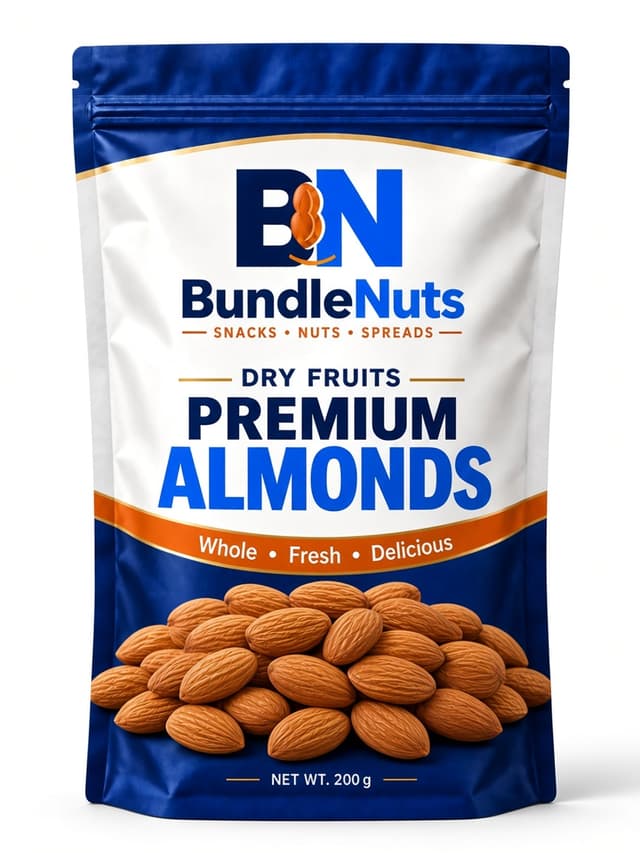
For an optimal wellness protocol, consume both: enjoy a portion of [BN BundleNuts Premium Almonds](/products/dry-fruits/premium-almonds) during mid-morning desk hours or tea time for gut motility and steady glycemic focus, and savor a handful of [BN BundleNuts Premium Walnuts](/products/dry-fruits/premium-walnuts) with breakfast oatmeal or evening fruit platters to nourish vascular endothelial tissue and cognitive longevity.
“California almonds dominate in dietary fiber (~12.5g/100g), plant protein (~21.2g/100g), and antioxidant Vitamin E (~25.6mg/100g), whereas English walnuts are peerless in plant-based Omega-3 ALA (~9.1g/100g) and brain-protective ellagitannins.”
Botanical Origins & Matrix Morphology: Drupe Seed vs Brain-Lobed Kernel
The distinct textural experience and nutritional profiles of almonds and walnuts originate in their botanical lineage and cellular architectures:
• **California Almond (*Prunus dulcis*):** Botanically classified as a drupe fruit from the Rosaceae family, the almond kernel is the edible seed nestled inside a hard woody endocarp shell, which itself is enclosed within a green leathery hull. The kernel features a protective, papery brown seed coat (pellicle) rich in catechin, epicatechin, and flavonol glycosides. Inside, tightly packed cotyledons store monounsaturated oleic lipids within resilient parenchymal cell walls that resist rapid mastication breakdown.
• **English Walnut (*Juglans regia*):** Belonging to the Juglandaceae family, the walnut is a furrowed drupe kernel resembling the human brain's cerebral hemispheres. The two convoluted cotyledon lobes are covered by a micro-thin, astringent pellicle containing concentrated **ellagitannins** (pedunculagin and tellimagrandin). Because walnut cotyledons store lipids predominantly as polyunsaturated fatty acids (PUFA), their cellular matrix is tender, buttery, and friable, melting easily upon mastication.
“Almonds store monounsaturated fats inside resilient fibrous cotyledons, whereas walnuts store delicate polyunsaturated fats within convoluted, ellagitannin-rich lobes.”
Fatty Acid Profiles: Plant Omega-3 ALA vs Monounsaturated Oleic Acid
Evaluating lipid chemistry reveals the single biggest nutritional divergence between almonds and walnuts:
• **Omega-3 Alpha-Linolenic Acid (ALA Dominance in Walnuts):** Walnuts are virtually unique among tree nuts for their massive concentration of **Alpha-Linolenic Acid (ALA)**, an essential n-3 polyunsaturated fatty acid. A single 28g–30g serving of walnuts supplies ~2.5g of ALA—comfortably exceeding the daily adequate intake (AI) recommended by ICMR-NIN and global cardiometabolic guidelines (1.1g to 1.6g/day). ALA serves as the biological precursor to elongated EPA and DHA, reduces circulating C-reactive protein (CRP), and preserves arterial endothelial elasticity.
• **Monounsaturated Oleic Acid (MUFA Dominance in Almonds):** In contrast, California almonds derive over 65% of their total fat from **Oleic Acid (C18:1)**, the same heart-healthy monounsaturated fatty acid celebrated in the Mediterranean diet. Oleic acid resists oxidative peroxidation significantly better than polyunsaturated fats, supporting healthy LDL-to-HDL cholesterol ratios while providing thermal stability during gentle roasting.
“Walnuts provide ~9.1g/100g of essential plant-based Omega-3 ALA for vascular elasticity, while almonds supply ~31.5g/100g of stable monounsaturated oleic acid.”
Antioxidant Dynamics: Alpha-Tocopherol Vitamin E vs Neuroprotective Ellagitannins
Both nuts offer formidable antioxidant defenses, but deploy entirely different biochemical compounds to protect human tissues:
• **Alpha-Tocopherol (Almonds):** Almonds are one of nature's richest whole-food sources of **Vitamin E** (~25.6mg per 100g, predominantly the bioavailable alpha-tocopherol isomer). Alpha-tocopherol embeds into cellular phospholipid bilayers, arresting lipid peroxidation chain reactions caused by environmental pollutants, UV exposure, and metabolic oxidative stress.
• **Ellagitannins & Urolithins (Walnuts):** Walnuts contain substantial levels of complex polyphenols known as **ellagitannins**. When ingested, colonic microflora metabolize walnut ellagitannins into bioactive **urolithins** (specifically Urolithin A), which cross the blood-brain barrier to trigger mitophagy (cellular mitochondrial recycling) and attenuate neuro-inflammatory pathways in aging brain tissue.
• **Mineral Micronutrient Spectrum:** Almonds lead in Calcium (~269mg vs 98mg/100g) and Magnesium (~270mg vs 158mg/100g) for neuromuscular tone and bone density. Walnuts counter with higher Copper (~1.6mg/100g) and Manganese (~3.4mg/100g), essential cofactors for endogenous antioxidant enzymes like superoxide dismutase (SOD).
Dietary Fiber, Glycemic Buffering & Satiety Kinetics
For professionals balancing intense work hours, preventing post-snack lethargy depends on how a food interacts with digestive transit and insulin signaling:
• **Almond Fiber Superiority:** California almonds supply an impressive **12.5g of dietary fiber per 100g** (both insoluble cellulose and soluble arabinogalactans). This high fiber content forms a viscous physical mesh in the stomach, slowing carbohydrate absorption and flattening postprandial glucose curves (GI < 15). Chewing crunchy almonds requires 30 to 45 seconds of active oral processing, sending early cephalic satiety cues to the brain.
• **Walnut Lipid Satiety:** Walnuts contain 6.7g of dietary fiber per 100g, relying primarily on cholecystokinin (CCK) hormone secretion triggered when high concentrations of polyunsaturated fatty acids reach the duodenum. This signals prolonged satiety to the brain, suppressing appetite for 3 to 4 hours.
“Almonds provide superior mechanical mastication and dietary fiber (~12.5g/100g), while walnuts trigger lipid-mediated hormonal satiety via rich polyunsaturated fats.”
Workday Desk Fuel, Breakfast Bowls & Evening Tea Pairings
Incorporate clean, nutrient-dense tree nuts into your daily lifestyle across these targeted occasions:
• **Mid-Morning Executive Desk Crunch (11:00 AM):** Keep a small bowl of [BN BundleNuts Premium Almonds](/products/dry-fruits/premium-almonds) or [Salted Roasted Almonds](/products/mehnga-sauda/salted-roasted-almonds) beside your keyboard. Their dry acoustic crunch provides mental stimulation without leaving oil marks on laptop trackpads or touchscreen phones.
• **Morning Wellness & Breakfast Integration:** Add 3 to 4 whole [BN BundleNuts Premium Walnuts](/products/dry-fruits/premium-walnuts) to your morning oats, smoothie bowl, or chia pudding. Walnuts soften pleasantly in liquids, imparting a rich, buttery depth and essential Omega-3 fatty acids to kickstart cognitive alertness.
• **Evening Chakhna & Unwinding Platters:** Pair cracked walnuts and roasted almonds with green tea or casual beverages. For festive entertaining or gifting, explore our curated [Diwali Dry Fruit Gift Boxes](/blog/diwali-dry-fruit-gifting-guide-2026) featuring almonds, walnuts, cashews, and pistachios in rigid presentation boxes.
FMCG Packaging Science: Defending Sensitive PUFA Lipids Against Rancidity
Because walnuts contain high concentrations of polyunsaturated fatty acids (over 47g PUFA per 100g), they are exceptionally vulnerable to hydrolytic and oxidative rancidity when exposed to heat, humidity, or oxygen:
• **Nitrogen-Flushed Barrier Pouches:** BN BundleNuts utilizes multilayer metallized foil pouches flushed with food-grade nitrogen gas. Displacing atmospheric oxygen halts the formation of volatile hexanal aldehydes, preserving kernel freshness and crisp texture.
• **Water Activity ($a_w$) & Humidity Control:** Kernel water activity is maintained below $a_w$ 0.40 to prevent enzymatic lipase activation. Once opened at home, reseal the zip-lock barrier pouch tightly and store in a cool, dark pantry shelf. During warm or humid months, storing walnut and almond pouches in the refrigerator extends natural crunch for up to 12 months.
Frequently Asked Questions About Almonds vs Walnuts
**Q1: Which is better for memory and brain health, almonds or walnuts?** Both support cognitive vitality through different mechanisms. Walnuts are widely regarded as the ultimate brain food because their extraordinary plant-based Omega-3 ALA (~9.1g/100g) and polyphenol ellagitannins directly nourish neuronal membranes and combat neuro-inflammation. Almonds provide high Vitamin E (~25.6mg/100g) and magnesium, which protect cerebral microvessels and support neurotransmitter synthesis.
**Q2: Which nut is better for weight loss, almonds or walnuts?** Both fit perfectly into weight-management diets. Almonds offer an advantage in dietary fiber (~12.5g vs 6.7g per 100g) and lower calorie density (~579 kcal vs ~654 kcal per 100g), requiring deliberate oral chewing that curbs overeating. Portion control (25g–30g daily) is recommended for both.
**Q3: Can I eat both almonds and walnuts every day?** Yes! Consuming a combined handful of 4–5 whole almonds and 2–3 walnut halves daily provides a complete spectrum of monounsaturated fats, essential Omega-3 ALA, Vitamin E, magnesium, and dietary fiber.
**Q4: How does BN BundleNuts guarantee freshness in walnuts and almonds?** BN BundleNuts sources grade-verified California Nonpareil almonds and extra-light whole walnut halves. Packed under strict FSSAI hygiene standards in multilayer metallized foil pouches with nitrogen gas flushing, our nuts remain fresh and free from rancid off-flavors.