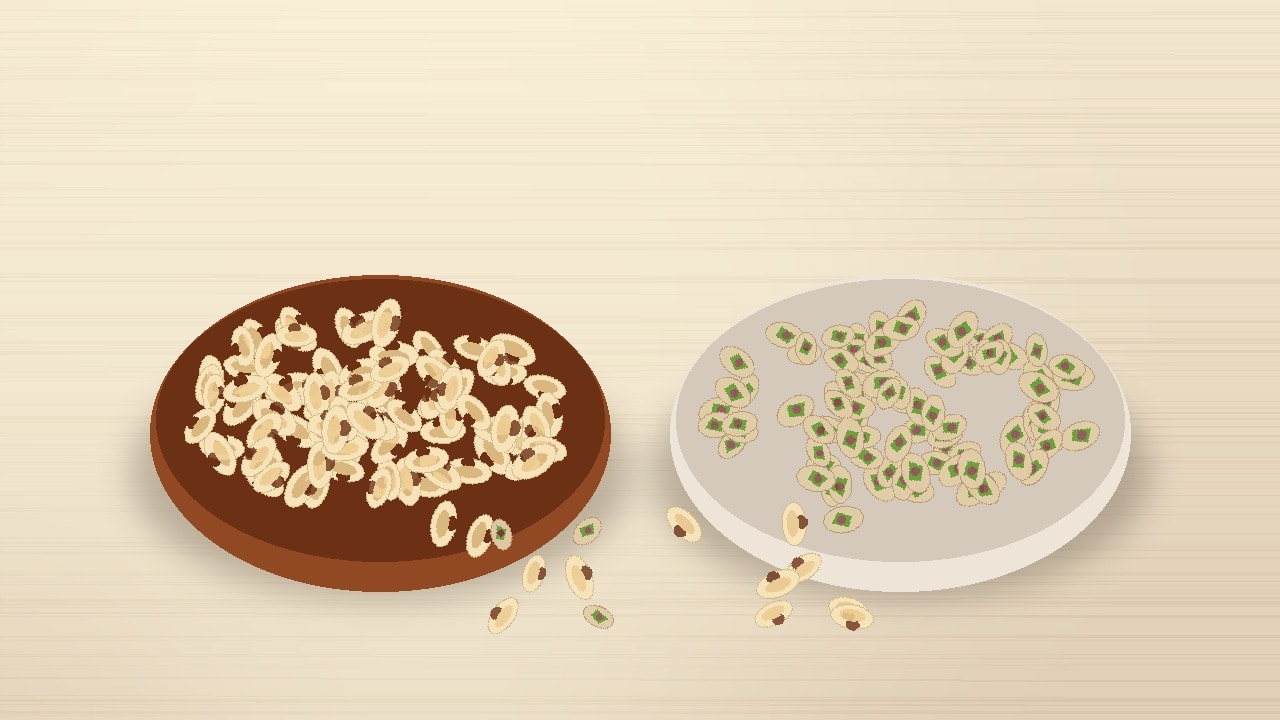
Roasted Cashews vs Roasted Pistachios: Which Tree Nut Belongs on Your Table?
Both hot-air roasted Cashews (*Anacardium occidentale*) and hot-air roasted in-shell Pistachios (*Pistacia vera*) represent premier pillars of luxury Indian snacking, workplace desk fuel, and festive chakhna within the [BN BundleNuts Mehnga Sauda](/products/mehnga-sauda) and [Dry Fruits](/products/dry-fruits) categories. However, their biological structures, micronutrient profiles, and eating mechanics serve distinctly different functional roles in a daily diet.
Choose **Roasted Cashews** if your goal is maximum bioavailable mineral density—specifically Magnesium (~292mg per 100g), Iron (~6.7mg per 100g), and Zinc (~5.8mg per 100g)—alongside a buttery, melt-in-mouth mouthfeel that provides quick cognitive energy conversion during high-intensity workday sessions. Choose **Roasted Pistachios** if you require higher dietary fiber (~10.6g per 100g vs 3.3g in cashews), massive Potassium density (~1025mg per 100g for cardiovascular electrolyte balance), rich Vitamin B6, and the 'Pistachio Effect'—where the physical act of de-shelling slows consumption speed and fosters tactile mindful snacking.
For an optimal daily routine, alternate between the two: enjoy crisp, lightly salted roasted cashews during mid-morning work blocks for sustained mineral fuel, and savor in-shell roasted pistachios during evening tea-time or social gatherings for relaxed, portion-controlled crunch.
“Roasted cashews lead in bioavailable magnesium (~292mg/100g) and iron (~6.7mg/100g), whereas roasted pistachios excel in potassium (~1025mg/100g), dietary fiber (~10.6g/100g), and tactile de-shelling satiety.”
Botanical Origins & Matrix Science: Drupe Seed vs In-Shell Kernel
Understanding the structural divergence between cashews and pistachios requires examining their botanical morphology and cellular architectures:
• **Cashew Kernel (*Anacardium occidentale*):** Cashews develop as kidney-shaped seeds suspended beneath the fleshy cashew apple. The raw kernel is protected by a toxic double shell containing anacardic acid and cardol (cashew nut shell liquid, CNSL). Commercial processing involves steaming and precision decortication to liberate the clean ivory-white cotyledons. When hot-air dry roasted at 130°C–150°C, the soft cell walls gelatinize slightly, creating a smooth, creamy texture with subtle toasted notes.
• **Pistachio Kernel (*Pistacia vera*):** Pistachios are drupe fruit seeds enclosed in a hard, woody shell. As the pistachio kernel ripens on the tree, it expands internally and splits the shell naturally along its longitudinal seam (known as 'naturally opened' in trade grading). Hot-air roasting inside the protective shell toasts the kernel evenly while preserving delicate chlorophyll pigments (giving the nut its vibrant green hue) and purple anthocyanins in the outer pellicle skin.
“Cashew kernels require decortication to release creamy cotyledons, whereas pistachios toast inside naturally split woody shells to protect chlorophyll and pellicle antioxidants.”
Macronutrient Breakdown: Magnesium, Potassium, Fiber, and Lipids
According to the Indian Food Composition Tables (IFCT) published by ICMR-NIN and USDA FoodData Central benchmarks, 100g of dry-roasted cashews and dry-roasted in-shell pistachios display the following nutritional profiles:
• **Magnesium & Iron Superiority (Cashews):** Dry-roasted cashews supply an extraordinary 292mg of Magnesium per 100g (meeting over 70% of daily recommended intake), alongside 6.7mg of Iron and 5.8mg of Zinc. Magnesium acts as a cofactor in over 300 enzymatic reactions, regulating ATP energy production, muscle contraction, and neuromuscular relaxation.
• **Potassium & Electrolyte Dominance (Pistachios):** Dry-roasted pistachios deliver 1025mg of Potassium per 100g—more than double the potassium of bananas. Potassium counteracts dietary sodium, supports arterial elasticity, and maintains intracellular fluid balance.
• **Dietary Fiber & Gut Motility:** Pistachios dominate in dietary fiber, supplying 10.6g per 100g compared to 3.3g in cashews. High insoluble cellulose and soluble pectin in pistachios support beneficial colonic microflora and regular bowel transit.
• **Lipid Profile & Calorie Density:** Cashews provide ~553 kcal and 43.8g of total lipids per 100g (rich in oleic acid MUFA and stearic acid), yielding a creamy mouthfeel. Pistachios contain ~560 kcal and 45.3g of total lipids per 100g, with a higher proportion of linoleic acid PUFA.
Satiety Mechanics & 'The Pistachio Effect': Tactile Mindful Snacking
A unique behavioral phenomenon documented in nutritional psychology is **The Pistachio Effect**—the measurable reduction in total caloric intake achieved when snacking on in-shell nuts compared to pre-shelled nuts:
• **Tactile Pacing & Visual Feedback:** Cracking open pistachio shells requires active manual dexterity and slows down consumption speed by 30% to 50%. Furthermore, leaving the empty split shells visible on a desk or table provides visual feedback to the brain, signaling cumulative portion volume and reducing mindless overeating by up to 41% without decreasing satiety.
• **Oral Mastication & Satiety Signaling (Cashews):** While pre-shelled roasted cashews can be consumed more rapidly, their dense, creamy cotyledons stimulate salivary flow and trigger gastrointestinal release of cholecystokinin (CCK) and peptide YY (PYY), providing sustained fullness between main meals.
“De-shelling in-shell pistachios provides visual feedback and slows eating speed, reducing total consumed calories while maintaining complete satisfaction.”
Workday Desk Snacking & Evening Chai Pairings: Clean Non-Greasy Roasting
In modern Indian offices and tea-time rituals (4:00 PM to 7:00 PM), tree nut snacks must be non-greasy and easy to consume while working on touchscreens and laptop keyboards:
• **Salted & Masala Roasted Cashews:** Hot-air roasted whole cashews (graded W240/W320) tossed in rock salt or authentic Indian chatpata spices pair exceptionally well with warm cutting chai, filter coffee, or green tea. Micro-mist spice adhesion binds seasonings firmly to the nut surface without leaving sticky oil marks on keyboards.
• **In-Shell Salted Roasted Pistachios:** Lightly salted roasted pistachios offer an interactive, acoustic crunch that serves as an elevated desk nibble, travel fuel, or evening social chakhna spread.
FMCG Packaging Science: Barrier Foils & Zero Trans Fats
Tree nuts contain delicate unsaturated fatty acids susceptible to oxidative rancidity when exposed to atmospheric humidity, light, or oxygen:
• **100% Hot-Air Dry Roasting:** BN BundleNuts utilizes continuous dry hot-air roasting chambers rather than continuous oil fryers. This eliminates saturated palm oil absorption and guarantees zero trans fats.
• **Multilayer Metallized Barrier Pouches:** High-barrier foil laminated pouches block 100% of ambient light, oxygen, and moisture, keeping kernel water activity below $a_w$ 0.35.
• **Nitrogen Gas Flushing:** Displacing atmospheric oxygen with food-grade nitrogen gas halts lipid oxidation, ensuring cashews and pistachios retain factory-fresh crunch and golden aroma for 6 to 9 months.
Frequently Asked Questions About Roasted Cashews vs Roasted Pistachios
**Q1: Which nut has more protein, roasted cashews or roasted pistachios?** Dry-roasted pistachios supply slightly higher plant protein density (~20.2g per 100g) compared to dry-roasted cashews (~18.2g per 100g). Both provide rich bioavailable essential amino acids.
**Q2: Is roasted cashews or roasted pistachios better for weight management?** Both are excellent low-glycemic snacks! Pistachios offer a distinct behavioral advantage due to 'The Pistachio Effect'—cracking in-shell pistachios slows consumption speed and provides visual shell cues that reduce overall caloric intake. Cashews provide higher magnesium and iron for energy metabolism.
**Q3: Do BN BundleNuts cashews and pistachios contain added oil or trans fats?** No! BN BundleNuts uses 100% hot-air dry roasting instead of deep oil frying. A microscopic edible oil mist is used solely to adhere ground spices to kernel surfaces.
**Q4: How should I store opened pouches of cashews and pistachios?** All BundleNuts products feature resealable zip-lock barrier pouches. Keep the pouch sealed in a cool, dark pantry. In hot or humid weather, storing the pouch in the refrigerator keeps kernels extra crisp for months.